

Sourcing & Projects
Import Shower Valves from China: The 2026 Sourcing Guide
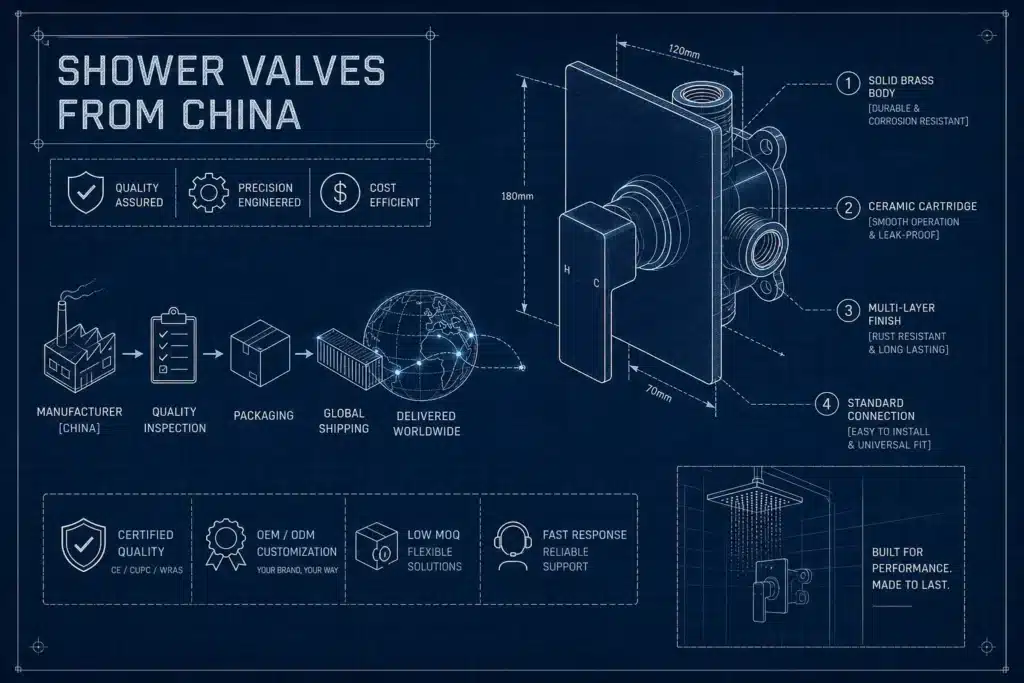
If you're looking to import shower valves from China, the margin math is worth running carefully. Domestic middlemen can add a significant markup to the landed cost of Chinese-manufactured shower valves before they reach your purchase order, in some distribution channels, that markup has been reported in the 30, 50% range, though actual figures vary by channel and product type. Factory-direct pricing from a vetted Chinese manufacturer can deliver meaningful savings, with some buyers reporting reductions of up to 30, 40% versus domestic sourcing for equivalent or better quality. Results depend on order size, product specs, and your total duty and freight exposure. That's not a small-batch pricing trick. It's a structural advantage that can reshape how competitive your catalog is.
The sourcing landscape in 2026 is more accessible than it was five years ago, but it's also more crowded with risk. Trading companies posing as factories and products with only EU certifications being sold into US markets are recurring traps. Inconsistent quality on bulk orders compounds the risk for buyers who skip the fundamentals. This guide covers the full picture: how to vet suppliers, what pricing and lead times actually look like, which certifications matter for US market access, the right HTS codes, and a step-by-step checklist that gets you from first contact to cleared customs. Manufacturers like FJ Concealed Shower, a China-based concealed shower specialist with 17 years in the category and 20-plus patents on file, represent what a legitimate factory-direct partnership looks like. That's the benchmark to hold every other candidate against.
Why US distributors are going factory-direct for shower valves
The margin math is straightforward once you run it. Domestic distribution layers can add substantially to the landed cost of shower valves before they reach your purchase order, industry reports from some channels put that figure in the 30, 50% band, though it varies considerably by supplier relationship and product tier. Factory-direct pricing eliminates that layer entirely, and the savings compound as order volume grows. For distributors moving 500 or 1,000 units per year, the difference isn't incremental; it restructures your margin profile.
Going factory-direct is also a supply chain control decision. When you own the relationship with the manufacturer, you control lead times, customization options, and quality standards at the source. Brands that have made this shift report faster response to product changes, the ability to private-label, and predictable pricing that isn't subject to domestic supplier adjustments.
One distinction matters here: not every "factory" operating on B2B platforms is a real manufacturer. The shower valve category has three distinct supplier types. Trading companies resell product they don't make, often with inconsistent sourcing and no engineering depth. OEM-capable factories manufacture product but may offer limited customization or technical support. Full-service manufacturing partners, the category FJ Concealed Shower operates in, combine production capability with dedicated engineering support, documentation infrastructure, and hands-on OEM flexibility. Knowing which type you're dealing with before you send a deposit is one of the most important sourcing decisions you'll make.
How to import shower valves from China: vetting suppliers before you commit
The red flags that expose trading companies and unreliable factories follow a recognizable pattern. Specs that shift between the initial quote, the sample, and the product sheet signal that no single source of truth exists internally. Missing or inconsistent business registration documents, no factory photos, and refusal to conduct a live video walkthrough all point to the same conclusion: the supplier doesn't want you to see behind the curtain. Prices dramatically below comparable market rates without technical justification should trigger the same reaction. In the shower valve category specifically, corner-cutting on materials is both easy to hide and consequential for plumbing code compliance and end-user safety.
Document and registration verification
Verification starts with the legal business registration certificate. Cross-reference the company name, address, and tax ID against official Chinese registries. Any mismatch between the registration document, the bank account name, and the invoice header is a disqualifier. Request a live video call walkthrough of the production floor, not pre-recorded footage. A legitimate manufacturer will accommodate this without friction. Refusal to show the factory in real time is itself a red flag, not a minor inconvenience.
Certification verification
For certifications, don't take the document at face value. Verify third-party lab reports and certification listings directly with the issuing body, whether that's IAPMO, NSF, or UL. Search the specific file number in their public database to confirm scope and current status. Suppliers claiming certifications they don't hold is a documented concern flagged by certifiers like NSF and IAPMO in their guidance on verification procedures. Finally, ask for customer references and independently confirm them. Call the references directly, ask specific questions about lead time reliability and quality consistency, and weigh what you hear against the supplier's own claims.
MOQs, FOB pricing, and lead times: what to expect in 2026
Brass thermostatic and mixer-style shower valves from Chinese factories run approximately $15, 65 per unit FOB for standard configurations. Complete premium shower systems with trim and accessories reach $99, 200 or more per set. Concealed thermostatic valves specifically range from $20, 50 FOB for budget configurations, $50, 110 for mid-range thermostatic systems, and $129 and above for high-end concealed setups. CIF pricing adds ocean freight and marine insurance on top of FOB, so build that uplift into your landed cost estimate from the start.
MOQs across most Chinese shower valve suppliers cluster at 10, 50, and 100 units for standard catalog items. For OEM or custom-finish orders, expect MOQs in the 50, 200 unit range at minimum. Sample orders serve a fundamentally different purpose than production MOQs. Most factories will supply 1, 5 sample units, and you should always evaluate samples against your spec before committing to any bulk quantity. Wholesale shower valves from China are generally priced more favorably at higher sample-to-production ratios, so confirm that dynamic with your supplier upfront.
Lead times follow a predictable structure. Stock or simple samples arrive in 3, 7 business days. Samples requiring a custom finish or logo approval run 7, 15 days. Standard bulk production takes 35, 40 days, with custom or peak-season orders stretching to 45 days or more. Ocean freight from China to a US port typically takes 20, 35 days. Add customs clearance time, and you're planning for roughly 8, 11 weeks from order confirmation to warehouse availability.
Certifications and HTS codes every US importer must know
The certification requirements for importing bathroom valves from China fall into two distinct categories: federal compliance requirements and market access certifications. On the federal side, lead-free compliance under the Safe Drinking Water Act is the baseline. NSF/ANSI 372 is the primary third-party certification standard for lead content in water-contact products. For many importers, third-party certification is required rather than self-certification, though the EPA's implementing guidance notes that product function and specific use context can affect which products fall under the requirement. Consult the EPA guidance directly or work with a compliance specialist to confirm your product's obligations. NSF/ANSI 61 addresses health effects and chemical leaching for water-contact components and is required by many buyers and specifiers regardless of the federal floor.
Code acceptance and US market certifications
For code acceptance, cUPC/UPC listing from a recognized certifier like IAPMO, NSF, or UL is the primary requirement in most US jurisdictions. ASSE 1016/ASME A112.18.1 is the core performance standard for thermostatic and pressure-balancing shower valves and directly affects specification and installation approval. One critical clarification: WRAS is a UK water-regulations mark and CE is an EU conformity designation. A supplier presenting only CE documentation is not code-compliant for the US market. Verify that the certification scope matches US standards before accepting any compliance claims.
HS code and HTS classification for shower valves
HTS classification determines your duty rate, so getting this right before you issue a purchase order matters. Note that "HS code" refers to the international Harmonized System nomenclature, while "HTS" is the US-specific Harmonized Tariff Schedule, the two systems share the same six-digit base codes, but the US HTS extends to 10 digits for more precise classification. When searching for HS code shower valves information, you may encounter either term; for US import purposes, the HTS code governs. The key codes and current general duty rates for 2026 are:
Bath and shower faucets (hand-operated):HTS 8481.80.10.20 / 8481.80.10.50, general duty rate approximately 4%; China-origin goods carry additional Chapter 99 surcharges that increase the effective rate materially, confirm the current surcharge with your customs broker, as rates are product-specific
Thermostatic shower valves: HTS 8481.80.90.45, MFN rate approximately 2%; China-origin goods carry additional Chapter 99 surcharges, an additional 7.5, 25% depending on product classification has applied to many valve categories, though the exact rate requires confirmation against current CBP guidance
Shower trim kit parts: HTS 8481.90.10.00, approximately 3%
Brass showerheads: HTS 7419.99.50.10, duty-free; plastic showerheads: HTS 3924.90.55.00, approximately 3.4%
These rates are based on the 2026 Revision 15 HTS schedule, but classification depends on the exact product description, function, and material. Consult a licensed customs broker for your specific product before entry. China-origin surcharges under Chapter 99 add significantly to the MFN base rates shown above, and those surcharges are product-specific.
Quality control steps that protect your bulk order
Pre-production sample approval is the step most importers skip and the one that causes the most expensive problems. Before bulk production starts, require a master sample approved for structure, finish, logo placement, and packaging. That master sample becomes the contractual production benchmark, any deviation in the batch can be rejected against it in writing. Specify that finish samples must be tied to the exact plating specification, because finish consistency is one of the most common failure points on shower valve orders.
In-production and pre-shipment inspection
In-production inspection should cover the dimensions and tolerances that determine function. Verify critical interfaces, thread specs, mounting points, and cartridge fit with attention to CNC machining consistency across the lot. Functional testing of valve operation, handle movement, diverter action, and cartridge smoothness on samples and the first production lot catches assembly problems before they're sealed into cartons. Leak and pressure testing with documented results is non-negotiable for any plumbing product. Require a defined percentage of the batch to be tested and documented before release.
Pre-shipment inspection should be conducted by an independent inspector or your own QC team after assembly and before the container is sealed. Require the factory to notify you in advance when production completes so inspection can be scheduled before packing release. This single step prevents the most common scenario: discovering problems after the goods are loaded and your leverage is gone.
Step-by-step checklist: how to import shower valves from China
The supplier qualification sequence runs in a specific order for a reason. Qualification has to precede sampling because sampling an unverified supplier wastes time and money, each step builds on the last, and skipping ahead creates gaps that surface as expensive problems later.
- Identify candidate suppliers through verified B2B platforms or direct factory referrals, not unsolicited outreach
- Request business registration certificate, factory credentials, and all certification documentation upfront
- Verify certifications directly with the issuing body using the listed file number; don't accept a PDF as proof
- Conduct a live video or in-person factory audit; refusal ends the evaluation
- Order samples and evaluate against your spec: finish, dimensions, cartridge feel, and packaging quality
- Confirm MOQ, FOB pricing, lead time, and payment terms in writing before proceeding
- Confirm HTS classification and applicable duty rate with a licensed customs broker before issuing a PO
- Issue the purchase order with explicit QC clauses, the master sample reference, and the pre-shipment inspection requirement written in
- Arrange marine cargo insurance and confirm port-to-warehouse logistics
- Commission or conduct pre-shipment inspection before the container is sealed
- Prepare CBP entry documentation: commercial invoice, packing list, bill of lading, and applicable certification documents
For US distributors and brands that want a direct manufacturing partner already operating within this framework, FJ Concealed Shower handles technical documentation, OEM customization, and quality assurance infrastructure in-house. That reduces the checklist burden on your side considerably, because the factory-level groundwork is already in place for US-market imports.
The bottom line on importing shower valves from China
Choosing to import shower valves from China is a proven path to meaningful cost reduction, buyers who follow the right framework have reported savings of up to 30, 40% versus domestic sourcing, though actual results depend on product type, order volume, and total duty and freight exposure. Supplier vetting, clear certification requirements, accurate HTS classification, and rigorous pre-shipment QC are non-negotiable steps. Each one compounds the others, and each one skipped creates a gap that shows up at the worst possible time.
For US distributors and brands looking for a manufacturing partner that already operates within this framework, FJ Concealed Shower offers factory-direct pricing, flexible OEM production, and hands-on technical support built specifically for the US market. The company specializes in concealed shower systems exclusively, which means the engineering depth, documentation, and quality infrastructure are aligned to this product category in a way that generalist faucet manufacturers aren't. Start with a direct factory conversation and a sample order before committing to volume. That's where the checklist begins, and it's the right place to start.